
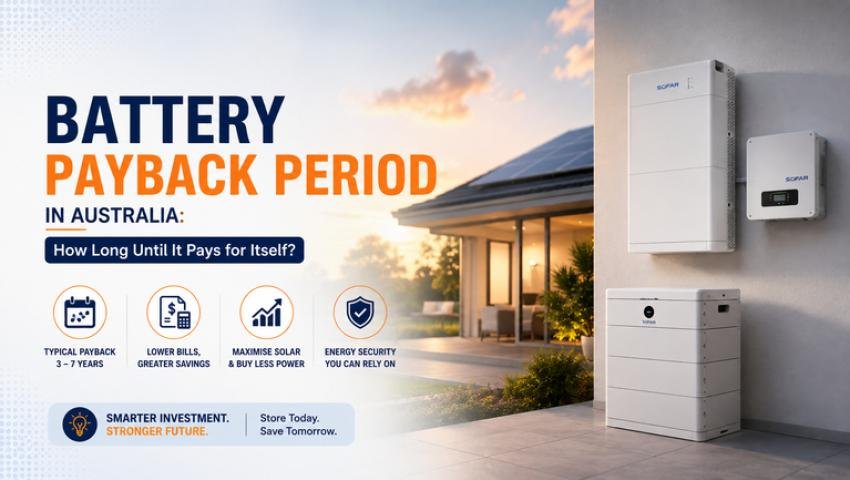
Battery Payback Period in Australia: How Long Until It Pays for Itself?
 By Samsun Energy
- Solar Batteries
- Aug 28, 2026
- 14 minutes read
- 19 Views
Discover how long a solar battery takes to pay for itself in Australia. Learn what affects battery payback, electricity savings, battery ROI, and how Samsun Energy helps homeowners and businesses choose the right battery storage solution.
Battery Payback Period in Australia: How Long Until It Pays for Itself?
Installing rooftop solar has become one of the smartest investments Australian homeowners and businesses can make.
But once the solar panels are installed, another question usually follows:
"Should I add a battery?"
And almost immediately comes the next one:
"How long will it take to pay for itself?"
It's a fair question. Battery storage is a significant investment, and naturally, people want to understand the financial return before making a decision.
The challenge is that there isn't a single answer. Unlike solar panels, whose savings are relatively easy to estimate from electricity generation, battery performance depends on how you use your electricity, when you use it, your electricity tariff, and whether you're already generating excess solar power.
For one household, a battery might become an excellent long-term investment. For another, it may be better to install additional solar panels first and add battery storage later.
In this guide, we'll explain what battery payback really means, what affects it, and how to determine whether battery storage is the right investment for your home or business.
What Does "Battery Payback Period" Actually Mean?
The payback period is simply the amount of time it takes for the savings generated by your battery system to recover its initial investment.
Think of it this way. Imagine your battery helps reduce your electricity purchases every day by storing excess solar energy that would otherwise be exported to the grid. Instead of buying electricity during expensive evening peak periods, you're using electricity that your own solar system generated earlier in the day.
Over time, those savings accumulate. Eventually, they equal the amount you originally invested in the battery system. That point is known as the battery payback period.
After that, the ongoing savings continue to provide value throughout the battery's remaining service life.
Why There Isn't One Simple Answer
One of the biggest misconceptions in the energy industry is hearing statements like:
- "Every battery pays for itself in seven years."
- "Batteries never pay for themselves."
Both statements oversimplify a much more complex picture. The reality is that battery payback varies from one property to another because every home and business uses electricity differently.
Factors that influence battery payback include:
- Your daily electricity consumption
- How much solar energy you generate
- When you use electricity
- Electricity tariff structure
- Feed-in tariff rates
- Battery size
- System design
- Future electricity prices
- Household lifestyle
- Business operating hours
This is why Samsun Energy starts every battery consultation with an energy assessment rather than recommending a battery based on average figures.
How Does a Battery Actually Save Money?
Many people assume batteries create electricity. They don't. Your solar panels generate electricity. Your battery stores electricity that would otherwise be exported to the grid.
Later—typically during the evening, overnight, or during periods of high electricity prices—that stored energy can be used to power your home or business. Instead of purchasing electricity from your retailer, you're using energy you've already generated.
This helps increase self-consumption, which is one of the biggest financial advantages of battery storage.
Solar Only vs Solar + Battery
Scenario 1 – Solar Without a Battery
During the day: Solar panels generate electricity. Your home uses some of it immediately. Excess electricity is exported to the grid.
Later that evening: Solar production stops. Your household purchases electricity from the grid.
Scenario 2 – Solar with Battery Storage
During the day: Solar panels generate electricity. Your home uses what it needs. Excess electricity charges the battery.
During the evening: The battery supplies stored solar energy. Less electricity is purchased from the grid.
For households with higher evening electricity use, this can significantly increase the value of the electricity generated by their solar system.
What Factors Affect Battery Payback?
There is no universal payback period because every property is unique. Here are the biggest influences.
1. Solar System Size
A battery performs best when there is enough excess solar energy available to charge it. If your solar system is too small, the battery may not reach full charge regularly. This reduces the amount of stored energy available later in the day.
2. Household Electricity Usage
Families who use most of their electricity during the evening often benefit more from battery storage than households that consume most of their energy during daylight hours.
3. Electricity Tariffs
The difference between buying electricity and exporting solar electricity has a significant impact on battery value. Where electricity purchased from the grid costs considerably more than the value received for exported solar energy, storing electricity for later use may improve the financial return.
4. Battery Size
Bigger isn't always better. A battery should match your solar generation, electricity consumption, and future expansion plans. Oversized batteries may remain partially unused. Undersized batteries may not provide sufficient evening energy. Correct sizing is essential.
5. Future Electricity Prices
Nobody can predict future electricity prices with certainty. However, if retail electricity prices increase over time while feed-in tariffs remain comparatively lower, storing and using your own solar energy may become increasingly valuable.
6. Lifestyle Changes
Many households today are preparing for electric vehicles (EVs), heat pump hot water systems, reverse cycle air conditioning, and home electrification. These technologies increase electricity demand. Planning your battery system with future energy use in mind can improve long-term value.
Residential vs Commercial Battery Storage
Battery storage isn't only for homeowners. Commercial organisations are increasingly exploring battery solutions as part of broader energy management strategies.
Residential Batteries
- Increase solar self-consumption
- Reduce grid electricity purchases
- Improve energy independence
- Prepare for future electrification
- Support backup power (where applicable)
Commercial Batteries
- Reducing peak demand charges
- Managing high electricity consumption
- Supporting operational resilience
- Integrating EV charging
- Improving sustainability performance
- Supporting ESG commitments
Because commercial energy profiles differ significantly from residential homes, every commercial battery project should be individually assessed.
Is Battery Storage Worth It Without Solar?
Technically, yes. Financially, it depends.
Without solar panels, a battery generally charges using electricity purchased from the grid. While there may be situations where time-of-use tariffs make this beneficial, battery storage typically delivers the greatest value when paired with a well-designed solar system.
This is why Samsun Energy usually considers battery storage as part of a complete energy strategy rather than a standalone product.
Choosing the Right Battery Matters
Not every battery suits every property. Some homeowners prioritise longer backup duration, smart monitoring, scalability, or premium performance. Businesses may prioritise higher capacity, demand management, integration with commercial solar, or future expansion.
At Samsun Energy, we help customers compare trusted battery manufacturers based on their requirements rather than recommending a single brand.
Our battery range continues to grow. We're continually expanding our portfolio with additional premium battery manufacturers and next-generation energy storage solutions that meet Australian standards and deliver reliable long-term performance. Our recommendations are based on your energy consumption, solar generation, future plans, budget, and property's electrical infrastructure—not simply on brand availability.
How Samsun Energy Helps You Maximise Battery ROI
Installing a battery isn't about buying the biggest unit available. It's about designing a system that works for your property.
Our process begins with understanding your energy usage. We assess electricity bills, solar generation, household or business consumption, future energy needs, battery compatibility, and available inverter technology.
From there, we recommend a battery solution designed to deliver long-term value rather than short-term sales.
Whether you're planning to add battery storage to an existing solar system or designing a completely new energy solution, our goal is to help you invest with confidence.
Real Australian Battery ROI Examples
Every home uses electricity differently. A battery that delivers excellent value for one household may not be the best investment for another. That's why battery storage should always be assessed based on your property's energy profile rather than industry averages.
Example 1 – Family Home in Melbourne
Property: 6.6kW Solar System, family of five, Reverse Cycle Air Conditioning, Electric Hot Water, high evening electricity usage.
Challenge: The household generated plenty of solar electricity during the day, but most family members were away at work or school. By the time everyone returned home, solar production had dropped significantly. The family relied heavily on grid electricity every evening.
Samsun Energy Solution: After reviewing electricity bills and consumption patterns, Samsun Energy recommended a battery sized to store surplus daytime solar generation rather than installing the largest battery available.
Outcome: The battery allowed the family to use more of their own solar electricity after sunset, reducing reliance on grid electricity during peak evening demand while preparing the home for future upgrades such as an electric vehicle.
Example 2 – Regional Home with Future EV Plans
A homeowner was planning to purchase an electric vehicle within the next two years. Instead of designing the system around current electricity consumption alone, Samsun Energy considered future EV charging, heat pump installation, additional air conditioning, and battery expansion capability. The result was a future-ready energy system designed to grow alongside the household's changing needs.
Example 3 – Commercial Warehouse
The warehouse operated daytime production, forklift charging, office operations, and security systems. Although rooftop solar supplied much of the daytime electricity demand, management wanted greater flexibility during late afternoon operations. Following a commercial energy assessment, Samsun Energy evaluated battery storage as part of the broader energy strategy rather than treating it as a standalone purchase.
Battery ROI Isn't Only About Electricity Bills
Many people assume battery payback is measured only by electricity savings. In reality, batteries can deliver additional value that isn't always reflected in a simple financial calculation.
Greater Energy Independence
Using more of the electricity generated by your own solar system.
Protection Against Future Electricity Price Increases
Although no one can predict future energy prices, generating and storing your own electricity provides greater control over ongoing energy costs.
Backup Power Capability
Some battery systems can provide backup power during outages when configured appropriately. This feature may be valuable for households with medical equipment, home offices, or businesses that rely on continuous power.
Supporting Home Electrification
Battery storage becomes increasingly valuable as households transition toward heat pump hot water, reverse cycle air conditioning, electric vehicles, induction cooking, and fully electric homes.
Virtual Power Plants (VPPs)
Battery storage is also creating new opportunities through Virtual Power Plants (VPPs). A VPP connects many individual battery systems into a coordinated network.
During periods of high electricity demand, participating batteries may be able to support the electricity grid under approved VPP programs. Participation rules, financial arrangements, and availability vary depending on the provider and location.
While not every battery owner will choose to participate, it's another reason why selecting a modern battery platform with advanced monitoring and connectivity can be beneficial for future flexibility.
Common Mistakes When Buying a Battery
Battery technology is improving rapidly, but many buyers still make avoidable mistakes.
Buying the Largest Battery Available
A larger battery doesn't automatically deliver better value. If your solar system cannot regularly charge it, much of the storage capacity may remain unused. Correct sizing is more important than maximum capacity.
Ignoring Future Energy Needs
Many households eventually install electric vehicles, heat pumps, additional solar panels, or reverse cycle air conditioning. Planning for these upgrades today helps avoid expensive modifications later.
Choosing Price Over System Design
A battery is only one part of the energy system. Performance also depends on solar generation, inverter compatibility, battery management software, installation quality, monitoring, and system configuration. This is why Samsun Energy designs complete energy solutions rather than selling batteries in isolation.
Not Understanding Warranty Terms
Battery warranties differ between manufacturers. When comparing products, it's important to review warranty period, energy throughput limits, performance guarantees, expansion capability, and Australian support. Rather than comparing warranty length alone, we help customers understand the practical differences between battery platforms.
Battery + Solar + Heat Pump + EV = The Future Home
Battery storage delivers the greatest long-term value when viewed as part of an integrated energy ecosystem.
Imagine a home where:
- Rooftop solar generates electricity during the day.
- A battery stores excess energy.
- A heat pump provides efficient hot water.
- Reverse cycle air conditioning heats and cools the home.
- An electric vehicle charges using self-generated electricity.
Instead of treating each technology separately, Samsun Energy helps homeowners design systems that work together. Planning for future electrification often delivers greater value than installing individual products one at a time.
Why Choose Samsun Energy?
Battery storage isn't just about choosing a brand. It's about choosing the right energy strategy. At Samsun Energy, we take the time to understand how your home or business uses electricity before recommending any battery solution.
Personalised Energy Assessment
Every recommendation begins with electricity bill analysis, solar generation review, household or business energy usage, and future expansion planning.
Battery System Design
We help customers choose battery capacity based on solar production, evening consumption, budget, backup requirements, and long-term goals. Rather than oversizing or undersizing the system, we design battery storage that aligns with your actual energy profile.
Trusted Battery Brands
Samsun Energy supplies and installs battery systems from respected manufacturers including GoodWe, FoxESS, Growatt, SolaX, and ESYHOME. As battery technology continues to evolve, we are actively expanding our portfolio with additional premium manufacturers.
Professional Installation
Our experienced installation teams follow Australian Standards, manufacturer specifications, and industry best practices to ensure every battery system is installed safely and performs reliably over the long term.
Ongoing Customer Support
Our relationship continues after installation. We support customers with battery monitoring, warranty assistance, future battery expansion, solar upgrades, heat pump integration, EV charging planning, and technical advice.
Our goal is to help you build an energy system that continues delivering value well into the future.
Frequently Asked Questions
How long does a battery take to pay for itself?
There is no universal payback period. It depends on your electricity consumption, solar generation, battery size, electricity tariffs, feed-in tariffs, installation cost, and future energy use. A personalised assessment provides the most accurate estimate.
Does every solar home need a battery?
No. Some households already use most of their solar electricity during the day. Others may benefit more from installing additional solar panels before considering battery storage.
Can I add a battery later?
Yes. Many homeowners install solar first and add battery storage later. Planning your solar system with future battery compatibility in mind is often a smart long-term strategy.
Is battery storage suitable for businesses?
Yes. Commercial battery storage can support energy management, demand reduction, operational resilience, and future electrification, depending on the business's energy profile.
Which battery brand is best?
There isn't one "best" battery for every property. The ideal solution depends on energy usage, budget, solar system, backup requirements, expansion plans, and smart energy management features. Samsun Energy compares multiple premium brands to recommend the most suitable option for your circumstances.
Final Thoughts
Battery storage is no longer just about storing electricity—it's about giving homeowners and businesses greater control over how and when they use energy.
The right battery can increase self-consumption of solar energy, reduce reliance on the grid, prepare your property for electric vehicles and home electrification, and support a more resilient energy future.
However, the best investment isn't always the biggest battery or the most expensive model. It's the battery that fits your energy usage, your property, and your long-term goals.
That's why understanding your battery payback period starts with understanding your energy profile.
Plan Your Battery Investment with Samsun Energy
At Samsun Energy, we help homeowners and businesses make informed decisions about battery storage through tailored advice and professional system design.
Our services include:
- ✔ Free Battery Consultation
- ✔ Battery Payback Assessment
- ✔ Solar + Battery System Design
- ✔ Residential Battery Storage
- ✔ Commercial Battery Storage
- ✔ Future EV Charging Planning
- ✔ Heat Pump Integration
- ✔ Premium Battery Brands
- ✔ Professional Installation
- ✔ Ongoing Technical Support
Whether you're installing your first battery or expanding an existing solar system, we'll help you choose a solution that delivers long-term value—not just today's savings.
Ready to find out if a battery is the right investment for your property?
Contact Samsun Energy today for a personalised battery assessment and discover how a well-designed energy storage system can help you maximise the value of your solar investment.
Explore More Resources
References
For authoritative information and to strengthen EEAT, reference:
- Clean Energy Council (CEC) – Home battery guides, approved products, installer accreditation, and consumer advice.
- Australian Renewable Energy Agency (ARENA) – Battery storage projects, industry insights, and renewable energy research.
- Department of Climate Change, Energy, the Environment and Water (DCCEEW) – National energy policy, electrification, and battery information.
- Battery manufacturer resources for GoodWe, FoxESS, Growatt, SolaX, and ESYHOME – Product datasheets, warranties, installation manuals, and technical specifications.
These resources complement Samsun Energy's practical expertise and help readers access the latest technical guidance while making informed decisions about battery storage investments.
Samsun Energy
Battery Storage Specialists

Samsun Energy
Leave a comment
Your email address will not be published. Required fields are marked *
